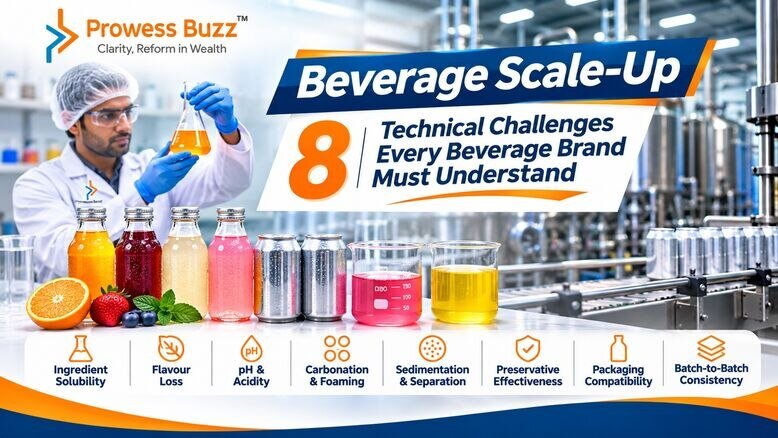
Beverage scale-up is one of the most critical stages of beverage product development. A formulation that performs perfectly in a laboratory may face significant technical challenges during commercial manufacturing. Understanding these challenges is essential for achieving consistent product quality, stability and successful commercialisation.
A beverage that performs perfectly in a 1-litre laboratory trial may behave differently in a 1,000-litre production batch. Changes in processing conditions, equipment, ingredient interactions and packaging can significantly affect the final product.
Understanding these technical challenges during beverage product development is essential for achieving consistent quality, product stability and successful commercialisation.
1. Ingredient Solubility During Beverage Scale-Up
During beverage scale-up, ingredient solubility and dispersion must be carefully monitored to maintain consistent product quality.
During commercial production, improper ingredient dispersion can result in:
- Sedimentation
- Undissolved particles
- Uneven ingredient distribution
- Cloudiness
- Inconsistent taste and appearance
The correct ingredient addition sequence, mixing speed, processing temperature and hydration time must be established during formulation development.
2. Flavour Loss During Thermal Processing
Beverages may undergo pasteurisation, hot filling or other thermal processing methods depending on their formulation and manufacturing requirements.
Certain flavour compounds are sensitive to elevated temperatures, which can result in:
- Reduced flavour intensity
- Loss of freshness
- Undesirable aftertaste
- Changes in aroma
- Development of cooked flavour notes
Flavour selection should therefore consider the actual commercial processing conditions rather than laboratory sensory evaluation alone.
3. pH and Acidity Variations
Maintaining consistent pH and acidity is critical for beverage quality, microbial stability and sensory performance.
Variations in water quality, raw material composition and ingredient dosing can influence the final beverage pH.
Improper pH control may affect:
- Preservative effectiveness
- Flavour perception
- Colour stability
- Ingredient compatibility
- Microbiological stability
Commercial formulations should have scientifically established pH specifications and appropriate quality control procedures.
4. Carbonation and Excessive Foaming
Carbonated beverages, energy drinks and functional sparkling beverages require careful control of carbonation during manufacturing.
Certain ingredients, particularly proteins, botanical extracts and some functional ingredient systems, may contribute to excessive foaming.
Common manufacturing challenges include:
- Carbon dioxide loss
- Excessive foaming during filling
- Inconsistent fill volumes
- Reduced carbonation retention
- Increased production wastage
Optimising beverage temperature, carbonation pressure, formulation composition and filling conditions can help improve production efficiency.
5. Sedimentation and Phase Separation
Physical instability is a common challenge in fruit-based beverages, protein drinks, herbal beverages and functional drinks.
A beverage may appear homogeneous immediately after production but develop visible separation during storage.
Potential causes include:
- Incompatible ingredients
- Differences in ingredient density
- Inadequate homogenisation
- Incorrect stabiliser selection
- Mineral and protein interactions
- Changes in pH
Addressing physical stability requires an understanding of ingredient functionality and appropriate processing technology.
Stabiliser selection, where applicable, must also comply with the relevant FSSAI regulations.
6. Preservative Effectiveness and Microbiological Stability
Adding preservatives does not automatically guarantee an extended shelf life.
Preservative effectiveness depends on multiple factors, including:
- Beverage pH
- Ingredient composition
- Initial microbial load
- Processing conditions
- Manufacturing hygiene
- Packaging integrity
- Storage temperature
A suitable preservation strategy must be developed based on the specific beverage formulation, intended storage conditions and applicable regulatory requirements.
Microbiological testing and scientifically designed shelf-life studies are essential for validating product stability and safety.
7. Packaging Compatibility
Packaging is an integral part of beverage product development, not simply a branding decision.
Different packaging materials, including PET bottles, aluminium cans and glass bottles, have different performance characteristics.
Incorrect packaging selection may contribute to:
- Carbonation loss
- Oxygen ingress
- Flavour deterioration
- Colour changes
- Packaging deformation
- Product leakage
- Reduced shelf life
Packaging compatibility should be evaluated during pilot production and shelf-life studies to ensure that the selected packaging supports the intended product quality and distribution conditions.
8. Batch-to-Batch Inconsistency
Maintaining consistent product quality across multiple production batches is one of the most important objectives of commercial beverage manufacturing.
Inconsistency may arise from:
- Raw material variations
- Incorrect ingredient weighing
- Changes in water quality
- Inadequate mixing
- Processing temperature fluctuations
- Lack of standard operating procedures
A standardised commercial formulation should include ingredient specifications, defined processing parameters, batch manufacturing instructions and quality acceptance criteria.
Importance of Pilot Production in Beverage Scale-Up
Pilot production is a critical stage of beverage scale-up, helping manufacturers identify technical challenges before commercial production
It allows beverage developers to evaluate product performance under representative manufacturing conditions and identify potential challenges before investing in bulk production.
A well-planned pilot trial helps establish:
- Commercial batch formulation
- Ingredient addition sequence
- Mixing and processing parameters
- Carbonation and filling conditions
- Packaging compatibility
- Production yield and losses
- Finished product quality specifications
- Preliminary manufacturing costs
Pilot production also provides representative samples for nutritional analysis, microbiological testing and shelf-life validation.
From Laboratory Formulation to Commercial Beverage Production
A structured beverage development process typically includes the following stages:
- Product concept and technical feasibility assessment
- Ingredient selection and regulatory evaluation
- Laboratory formulation and sensory trials
- Recipe standardisation
- Pilot production and process optimisation
- Nutritional and shelf-life testing
- Packaging and label validation
- Commercial manufacturing and quality standardisation
Each stage plays an important role in reducing technical risks and improving commercial readiness.
How ProwessBuzz Supports Beverage Scale-Up
At ProwessBuzz Services LLP, we provide end-to-end beverage consultancy services to help startups, entrepreneurs and established brands develop commercially viable beverage products.
Our technical expertise covers:
- Carbonated soft drinks
- Energy drinks
- Prebiotic and functional beverages
- Caffeinated and flavoured water
- Electrolyte and hydration drinks
- Zero-sugar and low-calorie beverages
- Ready-to-drink mocktails
- Fermented beverages and kombucha
- Fruit-based beverages
Our beverage consultancy services include custom formulation development, ingredient sourcing assistance, laboratory trials, pilot production, commercial scale-up, contract manufacturing assistance, FSSAI compliance, laboratory testing coordination and label validation.
Regulatory Considerations During Beverage Scale-Up
Beverage manufacturers must ensure that their formulations, ingredients, food additives and manufacturing practices comply with applicable Food Safety and Standards Authority of India (FSSAI) regulations. International food safety guidance published by the Codex Alimentarius Commission can also provide useful technical references for food and beverage manufacturers.
Conclusion
Professional beverage scale-up services help brands reduce manufacturing risks, optimise production costs and achieve consistent product quality.
Successful beverage commercialisation requires more than an attractive flavour and innovative product concept. It requires scientific formulation, process engineering, regulatory compliance, packaging compatibility and consistent manufacturing practices.
Identifying technical challenges during the development stage can help businesses reduce production losses, avoid unnecessary reformulation and improve finished product quality.
Planning to develop or commercially manufacture your own beverage product?
Connect with ProwessBuzz Services LLP — Food & Beverage Consultants, Pune, India.
From Concept to Commercialisation — Your Partner in Beverage Innovation.