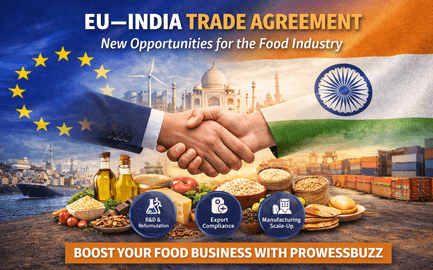
🇪🇺🇮🇳 EU–India Trade Agreement: What It Means for Food Manufacturers, Ingredient Suppliers & Exporters
The recently announced trade agreement between the European Union and India marks a significant shift in global agri-food trade. For India’s rapidly expanding food ecosystem, this agreement opens up new opportunities in sourcing, product innovation, exports, and manufacturing scale-up.
For food brands, ingredient suppliers, and processors, this is not just a policy update—it is a strategic inflection point.
🌾 Why the EU–India Trade Agreement Matters to the Food Industry
The agreement focuses on reducing and rationalising import duties across a wide range of agricultural and processed food products. Several European food ingredients and value-added products that earlier faced high tariffs are now expected to become more accessible to Indian manufacturers.
This directly impacts:
Food ingredient sourcing strategies
Cost optimisation for premium formulations
Global product benchmarking
Export readiness for Indian food brands
🍫 Ingredient Access & Product Innovation Opportunities
With easier access to European agri-food products, Indian manufacturers can strengthen their portfolios using:
Specialty edible oils (including olive oil variants)
Cocoa, chocolate, and bakery ingredients
Dairy-based ingredients and functional components
Value-added fruits, nuts, and processed agricultural inputs
This supports the development of clean-label, premium, functional, and export-oriented food products, aligned with global trends.
🧪 R&D, Reformulation & Manufacturing Impact
From a food R&D and manufacturing perspective, the agreement enables companies to:
Reformulate products using globally accepted ingredients
Improve sensory, nutritional, and shelf-life performance
Develop EU-compliant formulations for export markets
Scale up manufacturing with better process standardisation
However, these benefits can only be realised when R&D, compliance, and process engineering work together.
📦 Export Growth for Indian Food Brands
The agreement also strengthens market access for Indian exporters of:
Processed and packaged foods
Ready-to-eat and ready-to-cook products
Spices, seasonings, and blends
Functional and health-focused foods
That said, EU food safety regulations, traceability, labeling, and documentation standards remain stringent—making professional guidance critical.
⚠️ Compliance & Readiness: The Real Differentiator
While the trade agreement reduces barriers, it also raises expectations around:
EU-aligned food safety systems
Ingredient traceability and documentation
Clean labeling and nutritional compliance
Standardised manufacturing and quality controls
Food businesses that prepare early will gain a long-term competitive advantage.
🚀 How ProwessBuzz Helps Food Businesses Leverage This Opportunity
At ProwessBuzz Food Consultancy Services, we work closely with food manufacturers, startups, and ingredient companies to convert such policy changes into commercial success.
Our expertise includes:
Food product R&D and reformulation
Export-ready EU and international compliance
Ingredient selection and optimisation
Food manufacturing plant setup & scale-up
Quality systems, documentation, and regulatory support
Whether you are planning to source global ingredients, develop export-compliant products, or expand into international markets, strategic preparation is key.
📩 Final Takeaway
The EU–India Trade Agreement is a growth catalyst for the food industry—but success depends on technical readiness, regulatory alignment, and smart execution.
Food businesses that invest today in R&D, compliance, and scalable manufacturing will be best positioned to win tomorrow.
👉 Connect with ProwessBuzz Food Consultancy Services to turn this trade opportunity into a sustainable business advantage.