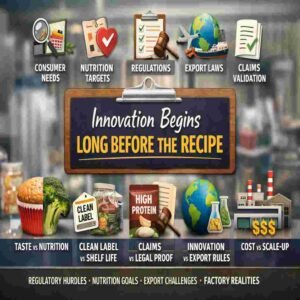
An Expert Perspective from a Food Consultant & Food Factory Consultant
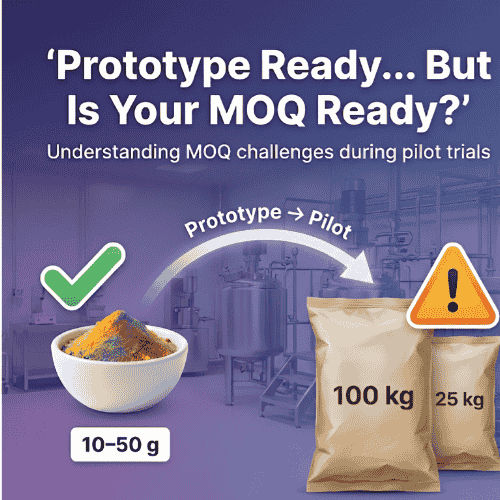
Scaling a food product from prototype to pilot manufacturing is one of the most demanding transitions for any brand. What seems like a simple jump in batch size often becomes complicated due to Minimum Order Quantity (MOQ) requirements from ingredient, packaging and co-packing suppliers.
For early-stage brands, ignoring MOQ realities leads to delays, increased costs, unnecessary wastage and even reformulation. As a Food Consultant, Food Factory Consultant and Food Business Consultant, we regularly guide founders through this critical phase and ensure their product is ready for manufacturing without operational surprises.
This detailed guide explains why MOQ planning matters, what challenges brands face, and how feasibility studies and professional food manufacturing consultancy solve the problem.
Understanding MOQ in Food Manufacturing
In commercial food production, suppliers set minimum order quantities to maintain consistency, efficiency and supply-chain reliability.
Common MOQ examples include:
Basic ingredients: 25–50 kg sacks
Flavours, stabilisers, colours: 5–25 kg drums
Nutraceutical and premium inputs: high MOQs with long lead times
Packaging materials: 5,000–20,000 printed units
Co-packer minimum run sizes: 100–500 kg depending on product category
These numbers are very different from R&D requirements, where prototypes use only a few grams.
Why MOQ Planning Is Essential for Scaling Your Product
1. Controls Cost and Prevents Overspending
Without planning, founders end up purchasing far more material than required for a pilot batch. This increases working capital pressure and limits cash availability for marketing or distribution.
2. Ensures Availability of All Inputs for Pilot Trials
Pilot manufacturing can start only when every raw material, packaging SKU, and processing input meets the supplier’s MOQ. Any one missing item can delay production.
3. Reduces Wastage and Storage Inefficiency
High-MOQ items with short shelf life can expire before commercial production begins.
4. Strengthens FSSAI Compliance & Documentation
Certified raw materials, batch traceability and proper supplier documentation are mandatory. MOQ-ready planning ensures compliant materials are procured.
5. Improves Supply-Chain Predictability
Understanding MOQs early helps build accurate manufacturing timelines and inventory plans.
Key Challenges Brands Face Without MOQ Planning
Suppliers refusing to provide smaller packs
Long lead times for functional or premium ingredients
High printing MOQs creating packaging bottlenecks
Co-packers rejecting non-traceable samples
Cost escalation due to unused raw materials
Frequent reformulations due to unavailable MOQ-friendly alternatives
These challenges directly impact the feasibility, cost, and scalability of the product.
A Strategic MOQ Framework Designed by Food Consultants
As a professional Food Business Consultant and Food Factory Consultant, we follow a structured approach to make products manufacturing-ready.
1. Complete Ingredient & Packaging Mapping
Standard pack sizes
MOQ for each input
Supplier certification
Shelf-life & handling requirements
Lead time assessment
2. Feasibility Study for Scale-Up
Our feasibility studies include:
Cost modeling for pilot and commercial batches
MOQ-sensitive formulation evaluation
Supply-chain risk identification
Pilot plant capacity alignment
Working capital estimation
3. Optimised Formulation for Lower MOQs
Where needed, we help modify formulations using:
Alternative suppliers
Concentrated inputs
Multi-functional ingredients
Raw materials with flexible MOQs
4. Packaging Strategy for Pilot Trials
To avoid high printing MOQs:
Use generic pouches
Adopt sticker or sleeve-based branding
Switch to MOQ-flexible packaging formats
5. Vendor Alignment & Procurement Planning
We coordinate with raw material vendors, packaging suppliers and co-packers to secure MOQ-compliant supplies.
6. FSSAI Compliance & Documentation
A plant-ready material list includes:
CoA
MSDS
Allergen declarations
Manufacturing licences
Food-grade certifications
This ensures pilot batches pass inspections effortlessly.
How Food Plant Setup Consultancy Supports Scale-Up
A Food Plant Setup team bridges the gap between R&D and commercial production by offering:
Equipment selection and line design
Batch size standardisation
Production loss estimation
Process flow development
On-site supervision during pilot trials
This helps founders avoid bottlenecks related to equipment capability and process consistency.
When Is the Best Time to Start MOQ Planning?
Immediately after your prototype is approved.
Starting early ensures: Accurate budgeting Alignment with suppliers Smooth planning for pilot trials Avoidance of last-minute reformulation Timely regulatory approvals
Conclusion: MOQ Determines Whether Your Prototype Becomes a Product
Successful food brands treat MOQ as a strategic element of product development. When combined with a structured feasibility study, expert food consultancy and strong supplier alignment, MOQ readiness becomes a competitive advantage