High protein claims are becoming increasingly common in India’s food and beverage industry. From protein bars and beverages to dairy products, snacks and bakery products, brands are using protein content to differentiate their products.
But there is an important distinction between declaring protein content and making a “High Protein” or “Rich in Protein” claim.
Under FSSAI’s Food Safety and Standards (Advertising and Claims) Regulations, 2018, nutrition claims must meet specified conditions.
Here is what food brands need to know before putting a high-protein claim on their packaging.
What Qualifies as “High Protein” Under FSSAI?
FSSAI specifies different requirements for a “Source of Protein” claim and a “Rich/High Protein” claim.
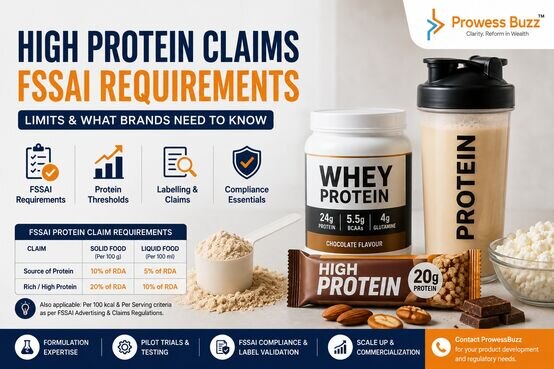
FSSAI Protein Claim Requirements
| Claim | Solid Food | Liquid Food |
|---|---|---|
| Source of Protein | 10% of RDA per 100 g | 5% of RDA per 100 ml |
| Rich/High Protein | 20% of RDA per 100 g | 10% of RDA per 100 ml |
The applicable criteria also include requirements based on 100 kcal and per serving. (fssai.gov.in)
The key point
A product containing a particular amount of protein per serving does not automatically qualify for a “High Protein” claim.
The finished product needs to be evaluated against the applicable FSSAI criteria.
“Source of Protein” vs “High Protein”
These claims should not be treated as interchangeable.
A “Source of Protein” claim has a lower threshold, while “Rich/High Protein” requires a higher protein contribution.
For example, the FSSAI threshold for a high-protein claim is:
- 20% of RDA per 100 g for solid foods
- 10% of RDA per 100 ml for liquid foods
This distinction should be considered during product formulation and NPD, rather than only when the label is being finalized.
How Should Brands Substantiate a Protein Claim?
A strong protein product should have a clear technical basis connecting the formulation to the final label.
Brands should maintain:
- Final product formulation
- Ingredient specifications
- Nutritional calculation
- Finished-product testing, where appropriate
- Product specification
- Regulatory basis for the claim
- Final approved label artwork
FSSAI’s Labelling and Display framework specifies the methodology for calculating protein from nitrogen:
Protein = Total Kjeldahl Nitrogen × 6.25
For milk, a conversion factor of 6.38 is specified. (fssai.gov.in)
The important principle is:
Formulation → Nutritional Calculation → Product Verification → Label Claim
Common Compliance Mistakes
1. Assuming “10 g Protein” Automatically Means “High Protein”
A statement such as “10 g Protein per Serving” is different from making a regulated “High Protein” claim.
The applicable FSSAI criteria must be satisfied.
2. Looking Only at Protein Per Serving
The claim should be evaluated using the applicable regulatory basis, rather than relying only on an attractive serving-size number.
3. Ignoring the Difference Between Solid and Liquid Products
The FSSAI thresholds are different for solids and liquids.
For example:
Solid: 20% of RDA per 100 g
Liquid: 10% of RDA per 100 ml
4. Relying Only on Raw-Material Protein
A protein ingredient may contain a high percentage of protein, but the final product will have a different protein concentration after other ingredients are added.
The finished product should therefore be the focus of the nutritional assessment.
5. Printing Packaging Before Claim Validation
Finalizing packaging before validating the claim can result in unnecessary:
- Packaging wastage
- Reprinting costs
- Launch delays
- Label changes
A better approach is:
Concept → Formulation → Regulatory Review → Testing → Label Validation → Commercial Production
What About Protein Beverages?
Protein beverages require additional attention because increasing protein can affect:
- Solubility
- Sedimentation
- Viscosity
- Flavour
- Mouthfeel
- pH stability
- Heat stability
- Shelf life
This becomes particularly important when developing clear protein beverages or protein waters, where consumers expect a light appearance and clean sensory profile.
Therefore, protein claim requirements should be considered alongside formulation, processing and stability during NPD.
High Protein Does Not Automatically Mean “Healthy”
A product can be high in protein while also containing significant amounts of:
- Added sugar
- Saturated fat
- Sodium
- Calories
Therefore, brands should consider the overall nutritional profile rather than focusing on protein alone.
A successful protein product needs to balance:
Nutrition + Taste + Stability + Compliance + Cost
Frequently Asked Questions
Is 10 g of protein enough to claim “High Protein”?
Not necessarily. The protein amount per serving alone does not determine whether the product qualifies. The applicable FSSAI criteria must be evaluated.
Can a protein beverage claim “High Protein”?
Yes, provided it meets the applicable FSSAI requirements and complies with the relevant labelling and advertising provisions.
What is the difference between “Source of Protein” and “High Protein”?
“Source of Protein” has lower thresholds than “Rich/High Protein.” A product may qualify for a source claim without meeting the requirements for a high-protein claim.
Does a protein product need laboratory testing?
Appropriate analytical testing can be an important part of nutritional verification and claim substantiation. The testing approach should be appropriate for the product and applicable requirements.
Can I use “Protein Rich” instead of “High Protein”?
Changing the wording does not automatically remove regulatory considerations. The proposed claim should be reviewed under the applicable FSSAI framework.
Developing a High-Protein Food or Beverage?
At ProwessBuzz Food Consultancy Services, we help food and beverage brands with:
- New Product Development (NPD)
- Protein formulation
- Beverage development
- Functional food development
- Pilot trials
- Nutritional assessment
- FSSAI compliance
- Label validation
- Contract manufacturing support
- Commercialization and scale-up
From Concept to Commercialization — We Help You Build Compliant, Scalable Food Products.
Contact ProwessBuzz to discuss your product development or regulatory requirements.
Regulatory Note
FSSAI regulations and amendments may change from time to time. The information in this article is intended for general guidance and is based on the FSSAI regulatory material reviewed at the time of publication.
Before finalizing packaging or commercializing a product, brands should verify the latest applicable FSSAI regulations, amendments and product-specific requirements.
Last reviewed: August 2026
Official References
- FSSAI – Food Safety and Standards (Advertising and Claims) Regulations, 2018
- FSSAI – Schedule I: Nutrition Claims
- FSSAI – Food Safety and Standards (Labelling and Display) Regulations, 2020