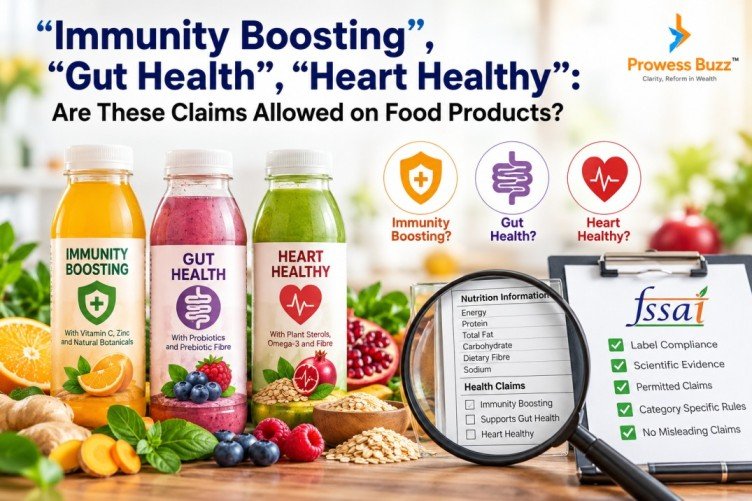
FSSAI health claims are an important consideration for food manufacturers, beverage brands, and food startups in India. Before using terms such as “Immunity Boosting,” “Gut Health,” or “Heart Healthy” on product labels or advertisements, businesses must assess the applicable FSSAI regulations, scientific evidence, and product-specific requirement
FSSAI Health Claims: Meaning and Regulatory Requirements
In today’s competitive food and beverage market, brands increasingly use health-focused messaging to attract consumers. Terms such as “Immunity Boosting,” “Gut Health,” “Heart Healthy,” and “Supports Digestive Health” are becoming common on beverage bottles, snack packaging, nutrition bars, dairy products, and functional foods.
For food businesses, these claims can help communicate a product’s intended benefits. However, a claim that sounds attractive from a marketing perspective is not automatically permitted under FSSAI regulations.
In India, claims made on food labels, websites, advertisements, social media posts, and other promotional materials must comply with the Food Safety and Standards (Advertising and Claims) Regulations, 2018, along with applicable amendments and relevant product-specific regulations. FSSAI requires claims to be truthful, meaningful, unambiguous, and not misleading. Official FSSAI regulations.
This guide explains how food brands should approach immunity, gut health, and heart health claims before launching a product or publishing marketing content.
1. What Are Health Claims Under FSSAI?
A health claim is a statement, representation, or suggestion that a relationship exists between a food or one of its constituents and health.
For example, a brand may communicate that a food contains a nutrient that contributes to a normal physiological function. Such a statement may qualify as a health claim and must meet the applicable regulatory requirements.
Health-related marketing can include:
- Claims about the physiological function of nutrients.
- Claims about the beneficial effects of food ingredients.
- Statements relating to digestive or gut health.
- Claims relating to normal immune function.
- Claims relating to cardiovascular health.
- Statements about reducing disease risk, where specifically permitted.
The regulatory assessment depends on the exact wording, the food category, the composition of the product, the scientific evidence, and the conditions specified in the applicable regulations.
Important: Adding an ingredient associated with a health benefit does not automatically allow a brand to claim that the finished product delivers that benefit.
2. Is “Immunity Boosting” Allowed on Food Products?
“Immunity Boosting” is a popular phrase in the functional food and beverage industry. It is used for products containing vitamins, minerals, botanical ingredients, and other functional components.
However, brands should not assume that this phrase is permitted simply because the product contains an ingredient associated with immunity.
What should businesses consider?
Before using an immunity-related claim, evaluate:
- Whether the product contains the relevant permitted nutrient or ingredient.
- Whether the ingredient is present at a level that supports the proposed claim.
- Whether the wording is supported by appropriate scientific evidence.
- Whether the claim is permitted for the particular food category.
- Whether the product complies with any applicable conditions and labelling requirements.
For example, a food containing vitamin C may potentially qualify for an appropriate claim relating to the normal function of the immune system, provided the applicable regulatory conditions are satisfied.
However, phrases such as “prevents infections,” “protects against disease,” or “guaranteed immunity” raise different and potentially impermissible implications. Food claims must not imply that an ordinary food can prevent, treat, or cure disease unless specifically authorised under the applicable legal framework.
Practical recommendation
Where supported and permitted, a precisely worded nutrient-function claim may be more appropriate than a broad, exaggerated promise.
The final wording must be checked against the current regulations and the product’s evidence rather than selected solely for marketing impact.
3. Is “Gut Health” Allowed on Food Products?
Gut health is a major area of innovation for probiotic beverages, fermented foods, yoghurt, fibre-enriched products, and prebiotic formulations.
However, the term “Gut Health” can communicate different things depending on how it is presented. It may imply digestive support, changes in gut microbiota, improved bowel function, or other physiological benefits.
Consequently, brands should assess the specific meaning conveyed to consumers.
Examples of products requiring careful claim assessment
Probiotic beverages: The identity, permitted use, viability, and relevant characteristics of the microorganism should be evaluated alongside the proposed claim.
Prebiotic drinks: The type and quantity of dietary fibre or other relevant ingredient should be checked against the applicable requirements and supporting evidence.
Fibre-enriched foods: Claims such as “Source of Fibre” or “High Fibre” must satisfy the prescribed compositional criteria for those nutrition claims.
Fermented beverages: Fermentation alone does not automatically establish that a product contains probiotics or provides a particular digestive benefit.
Can a brand write “Supports Gut Health”?
Not automatically. The phrase should be assessed as a health claim in context, including the product formulation, scientific substantiation, relevant regulatory provisions, and any product-specific requirements.
For certain probiotic, prebiotic, health supplement, or nutraceutical products, additional category-specific conditions may apply. Businesses should not assume that a claim suitable for one category can be transferred to another.
4. Is “Heart Healthy” Allowed on Food Products?
Heart-related claims require particular care because consumers may interpret them as promises about cardiovascular health or disease prevention.
A product’s nutritional composition may support certain permitted claims, but a brand cannot automatically describe a product as “Heart Healthy” simply because it contains oats, fibre, plant ingredients, or unsaturated fats.
What should be checked?
Before using heart-health messaging, assess:
- Total fat and the fatty acid profile, where relevant.
- Saturated fat and trans fat content.
- Sodium content, where relevant to the proposed claim.
- The quantity and type of any nutrient associated with the claim.
- Applicable conditions for nutrition and health claims.
- Scientific evidence supporting the exact wording.
- Whether the statement implies disease prevention or treatment.
For example, a permitted claim about replacing saturated fats with unsaturated fats may be different from a broad statement that a product prevents heart disease.
Similarly, a product that contains oats or dietary fibre cannot automatically claim to lower cholesterol without satisfying the applicable requirements for that specific claim.
Practical recommendation
Use only wording that accurately reflects the product’s verified nutritional characteristics and meets the relevant FSSAI requirements. Avoid suggesting that a food independently prevents cardiovascular disease or replaces medical treatment.
5. Health Claims vs. Nutrition Claims: What’s the Difference?
Understanding this distinction is essential for food product development and label validation.
| Claim type | What it communicates | What must be checked |
|---|---|---|
| Nutrition claim | A product contains a nutrient in a specified amount or meets a defined nutritional criterion | Prescribed compositional thresholds and conditions |
| Nutrient-function claim | A nutrient contributes to a normal body function | Permitted wording, nutrient levels, and applicable conditions |
| Other health claim | A food or constituent provides a specified health-related benefit | Regulatory eligibility and scientific substantiation |
| Disease-risk reduction claim | A food or constituent is associated with reducing a disease risk factor or risk | Specific regulatory conditions and any required prior approval |
| Disease treatment claim | A product treats or cures a disease | Ordinary food products cannot freely make such claims |
The precise classification depends on the wording and context. A short phrase on the front of a pack can have regulatory implications even when it is presented as a slogan.
FSSAI’s Advertising and Claims Regulations also establish requirements for claims related to dietary guidelines, healthy diets, and other forms of food marketing.
6. What Evidence Is Required to Support a Health Claim?
A claim should be supported before the product is launched, not only after a regulatory query is raised.
The evidence required depends on the type of claim, the product category, and the applicable rules. A structured review may include:
- Product formulation: Confirm the identity, source, and quantity of the relevant ingredients.
- Ingredient specifications: Obtain supplier specifications and certificates of analysis where appropriate.
- Scientific substantiation: Assess relevant scientific literature and evidence supporting the proposed benefit.
- Product-specific evidence: Determine whether additional analytical, stability, or other studies are needed to substantiate the claim.
- Regulatory review: Verify that the claim is permitted for the intended food category and complies with applicable conditions.
- Final label review: Ensure the wording, nutritional declaration, ingredient list, and accompanying statements are consistent.
A laboratory report confirming the presence of a nutrient does not, by itself, prove every health benefit that a brand may wish to advertise.
Likewise, evidence about an ingredient in isolation may not establish that the finished food delivers the same effect under the proposed conditions of consumption.
Where prior approval is required, businesses should follow the applicable FSSAI approval procedure before making the claim.
7. Common Health-Claim Mistakes Made by Food Brands
Many food businesses focus on packaging design and marketing before completing their regulatory assessment. This can create avoidable compliance risks.
Common mistakes include:
- Using “Immunity Boosting” merely because vitamin C or zinc has been added.
- Claiming “Gut Health” without assessing the relevant ingredient, quantity, and evidence.
- Using “Heart Healthy” without checking applicable nutritional criteria.
- Assuming that natural or traditional ingredients automatically qualify for health claims.
- Copying claims from competitors without verifying their regulatory basis.
- Using scientific studies on an ingredient to support an unrelated claim about the finished product.
- Making disease prevention or treatment promises through labels, advertisements, testimonials, or social media.
- Treating a disclaimer as a substitute for substantiating an otherwise misleading claim.
FSSAI’s rules apply to advertising and marketing communications as well as product labels. A claim published on a company website or social media account should therefore receive the same careful review as a statement printed on the package.
8. A Practical Compliance Checklist Before Launch
Before approving a health-related claim, food businesses should complete the following checks.
- Confirm the correct food category and applicable regulations.
- Verify that all ingredients are permitted for the intended use.
- Check ingredient quantities and relevant compositional thresholds.
- Identify whether the proposed wording is a nutrition claim, health claim, or disease-risk reduction claim.
- Compile appropriate scientific and technical evidence.
- Review the exact wording, implied meaning, and overall presentation.
- Check nutrition information and other mandatory label declarations.
- Confirm whether prior approval or additional category-specific requirements apply.
- Review packaging, website copy, advertisements, and social media content consistently.
- Maintain a record of the regulatory assessment and supporting documents.
This process is particularly important when developing functional beverages, nutraceuticals, protein products, probiotic foods, fortified foods, and botanical formulations.
9. How ProwessBuzz Helps Food Brands with Claim Compliance
At ProwessBuzz Food Consultancy Services, we support food startups, established manufacturers, and emerging beverage brands with product development and regulatory compliance.
Our services include:
- Food and beverage product development.
- Ingredient and formulation review.
- Nutrition and health-claim assessment.
- Nutritional analysis coordination and lab testing support.
- FSSAI licensing and regulatory documentation.
- Food label review and validation.
- Functional beverage formulation.
- Product standardisation and commercial scale-up.
- Technical documentation and manufacturing support.
We help businesses assess proposed claims early in the development process, reducing the risk of expensive label revisions and marketing changes after product launch.
Conclusion
“Immunity Boosting,” “Gut Health,” and “Heart Healthy” may appear to be simple marketing phrases, but each can communicate a health-related benefit that requires careful regulatory assessment.
Under India’s FSSAI framework, food businesses must evaluate the exact wording, product composition, scientific substantiation, food category, and applicable conditions before using such claims.
The key principle is simple: develop the product, establish the evidence, verify the regulatory requirements, and then finalise the claim.
Planning to launch a functional food or beverage? Contact ProwessBuzz Food Consultancy Services for support with formulation, label validation, and regulatory compliance from concept to commercialisation.