Low Fat, Fat-Free & Reduced Fat Claims: FSSAI Requirements Explained
FSSAI Low Fat Claims: Key Requirements
FSSAI Low Fat Claims are commonly used by food brands to communicate the fat content of a product. However, terms such as “Low Fat,” “Fat-Free” and “Reduced Fat” have specific requirements under FSSAI regulations. Understanding these requirements helps manufacturers and food businesses develop compliant labels, advertisements and product formulations.
Low Fat vs Fat-Free vs Reduced Fat
The basic difference is:
Low Fat: The product contains fat below a specified limit.
Fat-Free: The product contains only a very small amount of fat, within the specified limit.
Reduced Fat: The product contains significantly less fat than an appropriate comparable food.
FSSAI Fat Claim Requirements
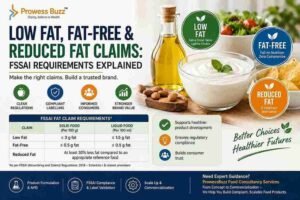
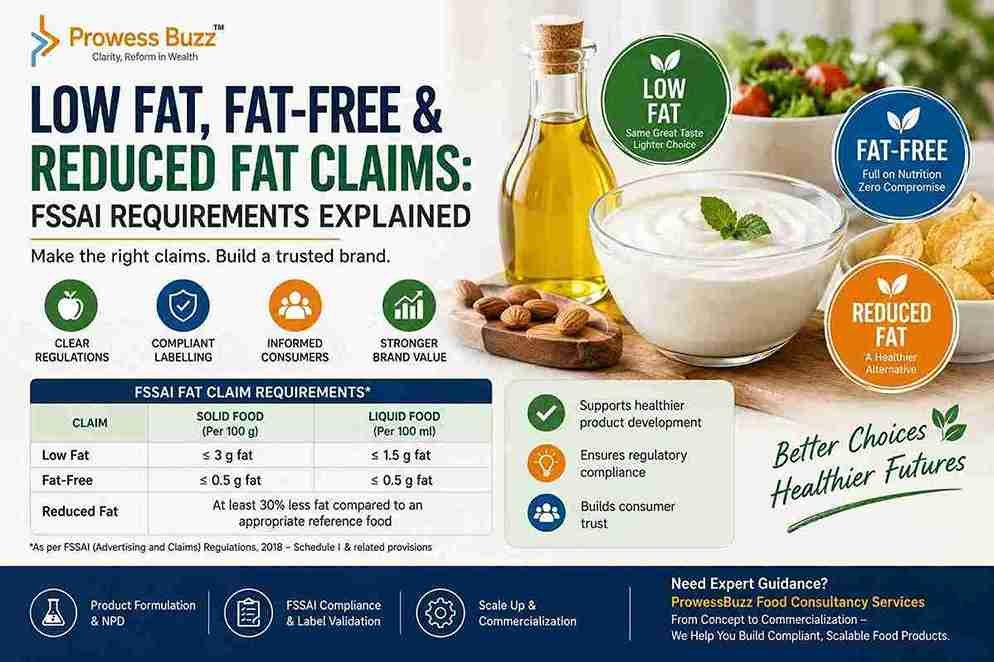
| Claim | Requirement |
|---|---|
| Low Fat – Solid | Not more than 3 g fat per 100 g |
| Low Fat – Liquid | Not more than 1.5 g fat per 100 ml |
| Fat-Free – Solid | Not more than 0.5 g fat per 100 g |
| Fat-Free – Liquid | Not more than 0.5 g fat per 100 ml |
| Reduced Fat | Comparative claim; applicable comparative-claim conditions must be satisfied |
The fixed thresholds for “Low” and “Free” are specified in Schedule I of the FSSAI Advertising and Claims Regulations.
What Does “Low Fat” Mean?
A “Low Fat” claim is a nutrient content claim.
For a solid food, the product must contain:
Not more than 3 g of fat per 100 g
For a liquid food:
Not more than 1.5 g of fat per 100 ml
This means that a product containing 2.5 g fat per 100 g may potentially meet the numerical criterion for a Low Fat claim, while a product containing 4 g per 100 g would not meet that criterion.
The assessment should be based on the applicable finished-product nutritional value.
What Does “Fat-Free” Mean?
The threshold for a “Fat-Free” claim is much lower.
The product must contain:
Not more than 0.5 g fat per 100 g for solids
or
Not more than 0.5 g fat per 100 ml for liquids.
Therefore:
Low Fat ≠ Fat-Free
A product that qualifies as Low Fat does not automatically qualify as Fat-Free.
Brands should also remember that FSSAI regulates claims that have the same meaning to consumers, not just one specific phrase.
What Does “Reduced Fat” Mean?
“Reduced Fat” is different from “Low Fat.”
Reduced Fat is a nutrient comparative claim because it compares the fat content of one food with another food.
FSSAI requires comparative claims to be made between different versions of the same food or similar foods, with the foods being compared clearly identifiable. Under the operationalized comparative-claim provision, the relative difference in nutrient content must be at least 30% for energy or nutrients other than micronutrients. The amount of difference and the identity of the reference food must also be provided in close proximity to the comparative claim.
Example
Suppose the reference product contains:
10 g fat per 100 g
A product marketed as “30% Reduced Fat” would need to demonstrate the required comparative reduction against that reference.
The comparison should be technically documented and clearly communicated.
Therefore, Reduced Fat does not mean “contains less than 3 g fat per 100 g.”
That is a common misunderstanding.
Low Fat and Reduced Fat Are Not the Same Claim
Consider these two statements:
Product A
“Low Fat”
This is assessed against the FSSAI’s fixed Low Fat threshold.
Product B
“30% Reduced Fat”
This is a comparative claim that depends on the fat content of an appropriate reference food and the required percentage difference.
A product could potentially be Reduced Fat compared with another product while still containing more than the fixed threshold for a Low Fat claim.
This is why brands should decide which claim they want to make before finalizing the formulation and label artwork.
What Should Brands Consider During Formulation?
Reducing fat is not simply a matter of removing oil or dairy fat.
Fat can contribute significantly to:
Taste
Mouthfeel
Texture
Emulsification
Creaminess
Moisture retention
Processing characteristics
Shelf life
Therefore, reducing fat can require reformulation.
For example, a reduced-fat bakery product may need adjustments to its:
Fat source
Water level
Emulsifier system
Texture
Flavour profile
Baking conditions
Similarly, a reduced-fat beverage or dairy product may require attention to body, stability and sensory characteristics.
A successful reduced-fat product therefore needs to balance:
Nutrition + Sensory Quality + Stability + Compliance + Cost
Common Compliance Mistakes
1. Assuming “Low Fat” Means “Fat-Free”
It does not.
The two claims have different thresholds.
Low Fat: ≤3 g/100 g for solids or ≤1.5 g/100 ml for liquids.
Fat-Free: ≤0.5 g/100 g or 100 ml.
2. Treating “Reduced Fat” as a Fixed Fat Limit
“Reduced Fat” is not simply another name for Low Fat.
It is a comparative claim and must be evaluated against an appropriate reference food.
3. Not Identifying the Reference Food
For a comparative claim, the food being compared must be clearly identifiable and the amount of difference should be provided in close proximity to the claim.
4. Changing the Formulation After Claim Validation
If the formulation changes after the claim has been validated, the fat content should be reassessed.
Changes in:
Oil/fat source
Dairy ingredients
Processing
Serving size
Ingredient suppliers
can affect the final nutritional profile.
5. Using “Lite” or Similar Terms Without Review
FSSAI’s Schedule II provides flexibility for certain synonymous wording, including terms associated with “Reduced” and “Low,” but the meaning and applicable conditions must not be altered.
Therefore, brands should not assume that changing “Reduced Fat” to “Lite” avoids the applicable claim requirements.
Product Categories Where Fat Claims Are Common
Fat-related claims can be relevant across many categories, including:
Dairy products
Milk-based beverages
Yogurt and fermented products
Bakery products
Biscuits and cookies
Snacks
Spreads
Sauces and dressings
Ready-to-eat foods
Frozen foods
Nutrition-focused products
Each product should be assessed based on its specific formulation and regulatory category.
A Practical Approach for Food Brands
Before approving a fat-related claim, brands should follow a simple process:
1. Define the intended claim
Low Fat, Fat-Free or Reduced Fat.
2. Evaluate the formulation
Calculate the expected fat content of the finished product.
3. Conduct product verification
Use appropriate nutritional assessment/testing where required.
4. For Reduced Fat, establish the reference
Identify the appropriate comparable food and document the comparison.
5. Validate the label
Ensure the nutrition panel and claim are consistent.
6. Review marketing communication
Check:
Packaging + Website + E-commerce + Social Media + Advertising
FSSAI requires claims to be truthful, meaningful and not misleading, and advertising claims should be consistent with the product label.
Frequently Asked Questions
What is the FSSAI limit for Low Fat?
For solid foods, the product must contain not more than 3 g fat per 100 g. For liquids, the limit is 1.5 g per 100 ml.
What is the FSSAI limit for Fat-Free?
The product must contain not more than 0.5 g fat per 100 g for solids or 100 ml for liquids.
Is Reduced Fat the same as Low Fat?
No. Low Fat is a nutrient content claim with a fixed threshold, while Reduced Fat is a comparative claim against another appropriate food.
How much reduction is required for a Reduced Fat claim?
Under the operationalized comparative-claim provision in the FSSAI Advertising and Claims framework, the relative difference for nutrient content claims is at least 30%, subject to the other comparative-claim requirements.
Can I use “Lite” instead of “Reduced Fat”?
Not automatically. Synonymous or alternative wording must still comply with the applicable conditions and must not change the meaning of the regulated claim.
Developing a Low-Fat or Reduced-Fat Product?
At ProwessBuzz Food Consultancy Services, we support food and beverage businesses with:
New Product Development (NPD)
Low-fat and reduced-fat formulation
Dairy and beverage development
Nutritional assessment
Pilot trials
FSSAI regulatory compliance
Label validation
Contract manufacturing support
Commercial scale-up
From Concept to Commercialization — We Help You Build Compliant, Scalable Food Products.
Contact ProwessBuzz to discuss your product formulation, regulatory or commercialization requirements.
Regulatory Note
FSSAI regulations and amendments may change from time to time. This article is intended for general information and should not replace a product-specific regulatory assessment.
Before finalizing packaging or commercializing a product, brands should verify the latest applicable FSSAI regulations, amendments, directions and product-specific requirements.
The FSSAI Advertising and Claims compendium reviewed for this article includes the operationalized amendments to the comparative-claim provisions.
Last reviewed: September 2026
Official Reference
FSSAI – Food Safety and Standards (Advertising and Claims) Regulations, 2018, Schedule I & Schedule II.