As consumers become more conscious of digestive health, nutrition and balanced diets, fibre has become an important product-positioning opportunity for food brands.
Claims such as “Source of Fibre,” “High Fibre,” and “Rich in Fibre” are increasingly seen on cereals, snacks, bakery products, nutrition products and other foods.
However, brands cannot use these claims simply because a product contains a fibre ingredient. The finished product must meet the applicable conditions under the FSSAI Food Safety and Standards (Advertising and Claims) Regulations, 2018.
Here is a practical guide for brands developing or marketing fibre-rich products.
What Is the Difference Between “Source of Fibre” and “High Fibre”?
The two claims have different thresholds.
According to Schedule I of the FSSAI Advertising and Claims framework:
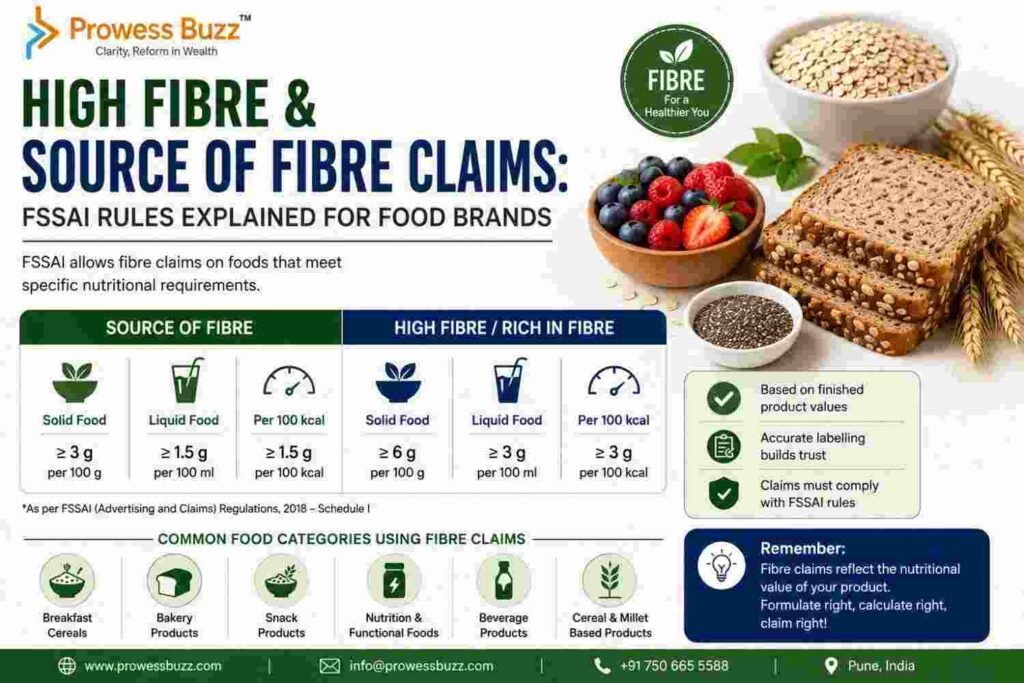
| Claim | Solid Food | Liquid Food | Per 100 kcal |
|---|---|---|---|
| Source of Fibre | At least 3 g/100 g | At least 1.5 g/100 ml | At least 1.5 g/100 kcal |
| High / Rich in Fibre | At least 6 g/100 g | At least 3 g/100 ml | At least 3 g/100 kcal |
(FSSAI)
In simple terms
A product containing 3 g of fibre per 100 g may meet the threshold for a Source of Fibre claim, subject to the applicable conditions.
For a High Fibre or Rich in Fibre claim, the product needs to reach 6 g of fibre per 100 g for a solid food.
For liquids, the corresponding thresholds are 1.5 g/100 ml for Source and 3 g/100 ml for High/Rich.
How Is Fibre Content Calculated?
The claim should be assessed based on the finished food, rather than simply looking at the fibre concentration of one ingredient.
For example, a cereal manufacturer may use:
- Oat fibre
- Wheat fibre
- Psyllium husk
- Inulin
- Resistant starch
- Other permitted fibre-containing ingredients
But the presence of a high-fibre ingredient does not automatically make the finished product eligible for a High Fibre claim.
The complete formulation needs to be evaluated.
A practical calculation
Suppose a snack contains 6 g dietary fibre per 100 g of finished product.
The product may meet the numerical threshold for a High/Rich in Fibre claim under the 100 g criterion, subject to all other applicable requirements.
Therefore:
Ingredient fibre content ≠ Finished-product fibre claim
The calculation should always be based on the appropriate finished-product nutritional value.
Fibre Claims and Nutritional Labelling
The fibre claim should be consistent with the nutritional information declared for the product.
Before approving the final packaging, brands should check:
- Fibre content in the formulation
- Nutritional calculation
- Finished-product analytical results, where appropriate
- Serving size
- Nutrition information
- Proposed front-of-pack claim
- Applicable FSSAI requirements
This creates a clear chain:
Formulation → Fibre Calculation → Product Verification → Nutrition Panel → Claim
If the formulation changes during product development or scale-up, the nutritional assessment should also be reviewed.
Common Food Categories Where Fibre Claims Are Used
Fibre claims can be particularly relevant for products positioned around nutrition, satiety or digestive wellness.
1. Breakfast Cereals
Cereals and granola products may use fibre as an important nutritional differentiator.
2. Bakery Products
Wholegrain breads, biscuits, crackers and other bakery products may be formulated to increase fibre content.
3. Snack Products
Brands developing healthier snacks may use fibre-rich ingredients to improve the nutritional profile.
4. Nutrition and Functional Foods
Fibre is commonly incorporated into products designed around specific nutritional positioning.
5. Beverage Products
Fibre can also be incorporated into selected beverages, although formulation challenges such as solubility, viscosity, sedimentation and sensory characteristics need to be considered.
6. Cereal and Millet-Based Products
Products based on cereals, millets and other plant ingredients may naturally contribute dietary fibre and can be evaluated for applicable fibre claims.
High Fibre Formulation: What Should Brands Consider?
Adding fibre to a formulation is not simply a matter of increasing the dosage until the desired claim is achieved.
Different fibre ingredients can significantly affect the product’s:
- Taste
- Texture
- Viscosity
- Solubility
- Water absorption
- Processing characteristics
- Shelf stability
- Mouthfeel
For example, increasing fibre in a beverage can increase viscosity or create sedimentation issues.
In bakery products, fibre can affect dough handling, moisture retention, texture and shelf life.
Therefore, the target claim should be considered alongside product formulation and processing requirements.
Common Compliance Mistakes
1. Assuming a Fibre Ingredient Automatically Qualifies the Product
Using psyllium, oat fibre, inulin or another fibre ingredient does not automatically allow a High Fibre claim.
The finished product must meet the applicable criteria.
2. Confusing “Source” With “High”
A product meeting the Source of Fibre threshold does not automatically qualify for a High Fibre claim.
The thresholds are different:
Source: 3 g/100 g for solids
High/Rich: 6 g/100 g for solids
3. Looking Only at the Serving Size
A brand may have a product containing a certain amount of fibre per serving, but the applicable FSSAI claim criteria should still be evaluated using the specified basis, including per 100 g, per 100 ml or per 100 kcal, as applicable. (FSSAI)
4. Finalising the Claim Before Formulation
A better approach is to establish the desired claim during NPD.
For example:
Target Fibre Level → Formulation → Pilot Trial → Nutritional Assessment → Regulatory Review → Label Validation
This can help prevent costly reformulation or packaging changes.
5. Using Additional Health Claims Without Separate Review
“High Fibre” is a nutrition claim.
Statements such as:
- Supports Digestion
- Improves Gut Health
- Promotes Weight Loss
- Keeps You Full
- Supports Blood Sugar Management
communicate additional benefits and should not automatically be treated as part of the High Fibre claim.
Any additional health or functional representation should be assessed separately under the applicable FSSAI requirements.
High Fibre Does Not Automatically Mean Healthier
A product can be high in fibre but still contain substantial amounts of:
- Added sugar
- Fat
- Saturated fat
- Sodium
- Calories
Therefore, brands should evaluate the overall nutritional profile rather than relying on a single positive nutrient claim.
A strong product should balance:
Fibre + Taste + Nutrition + Stability + Compliance + Cost
A Practical NPD Approach for Fibre Products
For brands developing a fibre-enriched product, a practical workflow is:
1. Define the target claim
Source of Fibre or High/Rich in Fibre.
2. Set the formulation target
Determine the fibre level required in the finished product.
3. Select the fibre source
Evaluate functionality, sensory impact, cost and processing compatibility.
4. Conduct pilot trials
Check texture, taste, solubility, viscosity and stability.
5. Verify nutritional values
Assess the finished product against the intended claim.
6. Review the label
Ensure the nutrition panel and claim are consistent.
7. Review marketing claims
Check packaging, website, e-commerce listings and social media for consistency.
Frequently Asked Questions
How much fibre is required for a High Fibre claim?
For solid foods, FSSAI specifies at least 6 g of fibre per 100 g for a “High” or “Rich” Fibre claim. For liquids, the threshold is 3 g per 100 ml. (FSSAI)
How much fibre is required for a Source of Fibre claim?
The threshold is 3 g per 100 g for solid foods or 1.5 g per 100 ml for liquids. The regulation also provides a per-100-kcal criterion. (FSSAI)
Can a product with psyllium claim High Fibre?
Potentially, yes. However, the presence of psyllium alone does not establish the claim. The finished product’s fibre content must meet the applicable criteria.
Can beverages make a High Fibre claim?
Yes, provided the finished beverage satisfies the applicable FSSAI criteria and other relevant requirements.
Is High Fibre a health claim?
“High” or “Rich in Fibre” is a nutrition claim. Additional statements about specific health benefits should be evaluated separately.
Developing a High-Fibre Food or Beverage?
At ProwessBuzz Food Consultancy Services, we support food and beverage businesses with:
- New Product Development (NPD)
- Fibre-enriched product formulation
- Functional food development
- Beverage formulation
- Pilot trials
- Nutritional assessment
- FSSAI regulatory compliance
- Label validation
- Contract manufacturing support
- Commercial scale-up
From Concept to Commercialization — We Help You Build Compliant, Scalable Food Products.
Contact ProwessBuzz to discuss your product formulation, regulatory or commercialization requirements.
Regulatory Note
FSSAI regulations and amendments may change from time to time. This article is intended for general information and should not replace product-specific regulatory assessment.
Before finalizing packaging or commercializing a product, brands should verify the latest applicable FSSAI regulations, amendments, directions and product-specific requirements.
FSSAI’s official website lists the amendments to the Advertising and Claims Regulations, including amendments issued in 2020 and 2022. (FSSAI)
Last reviewed: August 2026