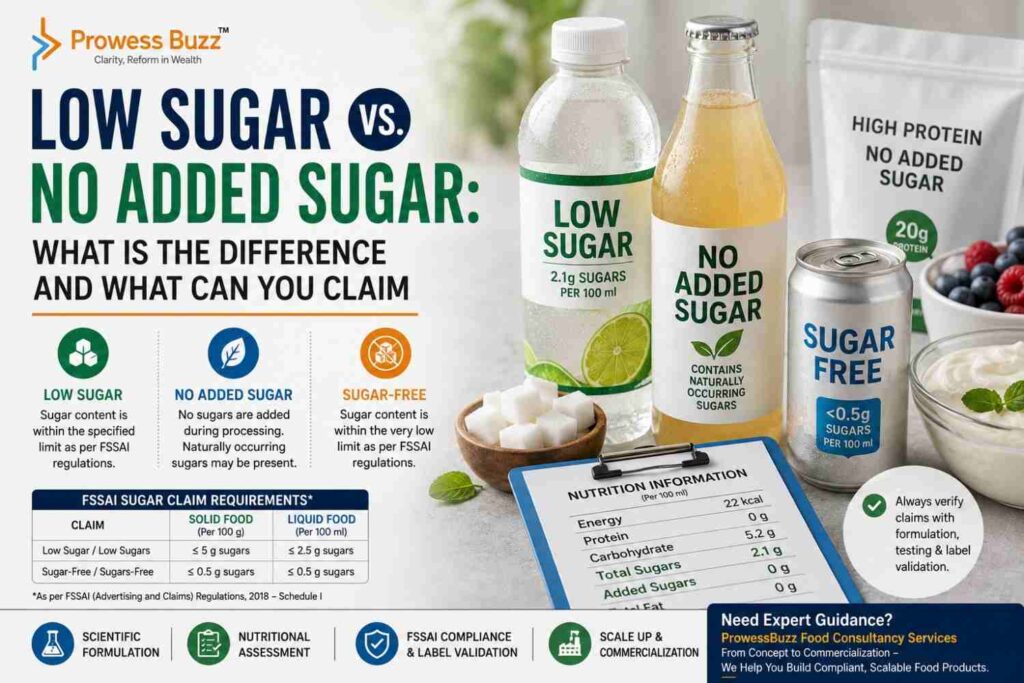
With growing consumer interest in healthier food and beverage choices, terms such as “Low Sugar,” “No Added Sugar,” “Sugar-Free,” and “Reduced Sugar” are increasingly appearing on product labels.
But these terms do not mean the same thing.
For food brands, using the right sugar claim is important because each claim has specific conditions under the Food Safety and Standards (Advertising and Claims) Regulations, 2018.
Understanding the difference before finalizing a formulation or packaging can help avoid unnecessary label changes and compliance issues.
Low Sugar vs. No Added Sugar: The Basic Difference
The simplest way to understand the difference is:
Low Sugar = The product contains sugar below a specified limit.
No Added Sugar = No sugars have been added to the product, subject to the applicable conditions.
Therefore, a product can be “No Added Sugar” but still contain naturally occurring sugars.
For example, a fruit-based beverage may contain naturally occurring sugars from fruit even when no sugar has been added.
What Does “Low Sugar” Mean Under FSSAI?
FSSAI’s Schedule I specifies conditions for nutrition claims such as “Low Sugars.”
The commonly applied thresholds are:
| Claim | Solid Food | Liquid Food |
|---|---|---|
| Low Sugar / Low Sugars | Not more than 5 g sugars/100 g | Not more than 2.5 g sugars/100 ml |
| Sugar-Free / Sugars-Free | Not more than 0.5 g sugars/100 g | Not more than 0.5 g sugars/100 ml |
FSSAI’s FAQ confirms that “Low Sugars” and “Sugars-Free” claims must comply with the conditions specified in Schedule I.
Important
“Low Sugar” does not mean that the product contains zero sugar.
It means that the total sugar content is within the applicable regulatory limit.
What Does “No Added Sugar” Mean?
“No Added Sugar” is different from “Low Sugar.”
Under FSSAI’s non-addition claim provisions, a no-added-sugar claim can be made when:
- No sugars of any type have been added to the food.
- Ingredients containing sugars as an ingredient have not been used.
- Ingredients containing sugars that substitute for added sugars have not been used.
- The sugar content has not been increased through processing, such as hydrolysis of starch to release sugars.
Naturally occurring sugars are allowed
A product can contain naturally occurring sugars and still make a No Added Sugar claim, provided the applicable conditions are satisfied.
Where naturally occurring sugars are present, FSSAI requires the indication:
“CONTAINS NATURALLY OCCURRING SUGARS”
to appear on the label.
No Added Sugar Does Not Mean Sugar-Free
This is one of the most common consumer and brand misunderstandings.
Consider a fruit beverage:
Fruit → naturally occurring sugars
If the manufacturer does not add sugar, the product may potentially qualify for a No Added Sugar claim, subject to all applicable conditions.
But it may not qualify as Sugar-Free, because it can still contain naturally occurring sugars.
Therefore:
No Added Sugar ≠ Sugar-Free
Similarly:
No Added Sugar ≠ Low Sugar
These claims should be assessed independently.
Low Sugar vs. No Added Sugar vs. Sugar-Free
| Claim | What it communicates |
|---|---|
| Low Sugar | The product’s sugar content is within the specified low-sugar limit |
| No Added Sugar | No sugars have been added, subject to the applicable conditions |
| Sugar-Free | Sugar content is within the very low limit specified for the claim |
| Reduced Sugar | A comparative claim indicating a reduction against an appropriate reference product, subject to applicable conditions |
This distinction is especially important when developing beverages, dairy products, bakery products, snacks and functional foods.
Common Mistakes Brands Make
1. Assuming “No Added Sugar” Means Zero Sugar
A product can contain naturally occurring sugars.
For example:
- Fruit
- Milk
- Certain grains
- Some other naturally sugar-containing ingredients
may contribute sugars to the finished product.
2. Using “No Added Sugar” When Sweetening Ingredients Are Used
A formulation should be carefully reviewed to identify ingredients that may contribute sugars or function as sweetening ingredients.
The claim should not be assessed only by checking whether the word “sugar” appears in the formulation.
3. Confusing Sugar-Free With No Added Sugar
These are different claims with different regulatory criteria.
A product that qualifies for No Added Sugar does not automatically qualify for Sugar-Free.
4. Checking Only the Recipe
For a commercial product, the claim should be assessed against the final formulation and finished product, along with the applicable labelling and regulatory requirements.
This is particularly important when formulations change during scale-up.
5. Making Different Claims on Different Platforms
The product label may say:
“No Added Sugar”
while the website or e-commerce listing may say:
“Sugar-Free”
This creates unnecessary regulatory risk.
Brands should review claims consistently across:
Packaging + Website + E-commerce + Social Media + Advertising
FSSAI also states that claims in advertisements should be consistent with the information on the food or beverage label and that advertisements must not be deceptive to consumers.
What About Sugar Substitutes?
Replacing sucrose with another sweetening system does not automatically mean that every sugar-related claim can be used.
During product development, brands should evaluate:
- Sweeteners used
- Sugar contribution
- Naturally occurring sugars
- Ingredient composition
- Processing conditions
- Final total sugar
- Intended claim
- Applicable FSSAI requirements
For beverages, the formulation may also need to balance sweetness, taste, mouthfeel, stability and shelf life.
For Beverage Brands: Formulation Comes Before the Claim
For products such as:
- Low-sugar beverages
- Zero-sugar beverages
- No-added-sugar drinks
- Functional beverages
- Fruit beverages
- Dairy beverages
- Energy drinks
the intended sugar claim should ideally be established during the NPD stage.
A practical development process is:
Target Claim → Formulation → Pilot Trial → Nutritional Assessment → Regulatory Review → Label Validation → Commercial Production
This can help prevent a situation where a product is already developed but the intended front-of-pack claim does not meet the applicable requirements.
Frequently Asked Questions
Can a No Added Sugar product contain sugar?
Yes. Naturally occurring sugars may be present. Where applicable, the label must indicate “CONTAINS NATURALLY OCCURRING SUGARS.”
Is No Added Sugar the same as Sugar-Free?
No. No Added Sugar relates to whether sugars have been added, while Sugar-Free is based on the applicable sugar-content threshold.
What is the FSSAI limit for Low Sugar?
The applicable Schedule I criterion is not more than 5 g sugars per 100 g for solids or 2.5 g sugars per 100 ml for liquids.
Can a fruit beverage claim No Added Sugar?
Potentially, yes, if it satisfies the applicable non-addition conditions. Naturally occurring sugars can still be present, and the required declaration should be considered.
Can I use “Zero Sugar” instead of “Sugar-Free”?
A claim with the same meaning as a regulated nutrition claim must satisfy the applicable conditions. Brands should therefore validate the exact wording before finalizing packaging.
Developing a Low-Sugar or No-Added-Sugar Product?
At ProwessBuzz Food Consultancy Services, we help food and beverage brands with:
- New Product Development (NPD)
- Low-sugar and sugar-reduction formulation
- Beverage formulation
- Functional beverage development
- Pilot trials
- Nutritional assessment
- FSSAI regulatory compliance
- Label validation
- Contract manufacturing support
- Commercial scale-up
From Concept to Commercialization — We Help You Build Compliant, Scalable Food Products.
Contact ProwessBuzz to discuss your product formulation, regulatory or commercialization requirements.
Regulatory Note
FSSAI regulations and amendments may change from time to time. This article provides general information based on the FSSAI regulatory material reviewed at the time of publication. Product-specific claims should be verified against the latest applicable regulations, amendments and directions before commercial launch.
FSSAI itself notes that its online compendia are ready-reference documents and that the original Gazette notifications/amendments prevail in case of any discrepancy.